Contact Us
National team

Find Your Local Sales Agronomist
About
With ongoing volatility in input costs, alongside the ever present climate challenges, Farmers and Agronomists are looking for reliable ways to optimise pasture productivity while reducing exposure to rising fuel and fertiliser prices without adding additional risk.
Rising fuel and urea costs remain a key concern. The price of synthetic Nitrogen fertilisers continues to fluctuate, and global pressures are creating uncertainty around future pricing and supply.
“Legumes provide a significant advantage here!” explains Tom Hunt from the DLF Seeds technical services team.
“When selected and managed correctly, legumes play a valuable role in pasture systems. They improve feed quality, support stronger animal performance, and provide a reliable source of biologically fixed Nitrogen that drives pasture growth and reduces reliance on synthetic fertiliser as the sole nitrogen source.
As legumes fix Nitrogen from the atmosphere over time, they can lower a pasture’s overall requirement for applied Nitrogen and from a cost perspective, that contribution can be significant.”
With fertiliser prices in early 2026 sitting around $1,500/t for urea (equivalent to approximately $3.26/kg of N), the Nitrogen supplied by a productive clover stand growing 3-4DM/ha/year and fixing 80 kg N/ha/year, may offset roughly $240–$325/ha/year in synthetic Nitrogen costs.
So when planning ahead for uncertain times, those savings really add up!” Explains Tom.
Nitrogen fixation from legumes is a dependable, natural process.
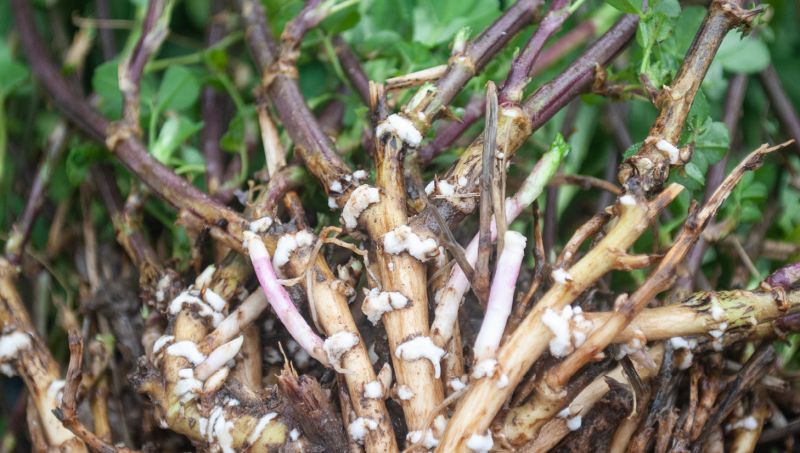
Through nodules on their root systems, legumes fix free atmospheric Nitrogen into the soil and improve overall pasture nutrition and production. Once fixed, Nitrogen is used by the legume to drive leaf growth, before being released back into the soil as plant material and roots break down


Although legumes enhance fertiliser efficiency and support companion grasses over time, they are unlikely to meet Nitrogen demand year round for a high performance pasture, so strategic applications of synthetic Nitrogen remain important, especially during establishment and high demand periods.
Liam DeNeefe, another member of the DLF Seeds technical services team, adds that “It’s a process you can actually see in the paddock, which can be really reassuring as you know it’s working.
If you dig up a white clover plant and cut open the nodules, a pink to red colour indicates active Nitrogen fixation. If nodules are white or pale, they are inactive or not yet effectively fixing Nitrogen.

Fixation activity increases as soil temperatures rise and conditions favour growth, so it’s worth keeping an eye on through the growing season.
It’s also important to use treated clover seed (Superstrike®), as this ensures the correct rhizobia inoculant is present from establishment, supporting early nodulation and Nitrogen fixation.”
These improvements directly support animal production. “That means more milk in the vat, higher milk solids, and improved liveweight gains in both sheep and cattle.
Legumes also play a key role in producing high quality hay and silage, providing reliable feed when seasonal conditions tighten.” Liam concludes.
Isaac Berry, DLF Seeds Technical Services Manager adds “In our internal trials, systems integrating high performance grasses with targeted urea applications have outperformed both synthetic Nitrogen only and legume only systems, delivering greater total dry matter production over 12 months.
In addition to the Nitrogen benefits, this lift in both feed quantity and quality directly supports improved animal performance, with legumes increasing metabolisable energy and crude protein levels within the sward”.
When legumes are paired with high performing grasses such as Base AR37 perennial ryegrass, Savvy cocksfoot or Quantica MaxP® tall fescue, overall system performance is further enhanced, helping stock reach target weights sooner.
“The benefits of legumes are maximised when species and varieties suit local conditions.”
New generation subterranean clovers, such as Australian bred Edison and Franklin, are suited to winter dominant rainfall zones, from marginal dryland through to higher rainfall environments. Yanninicum types like Franklin handle waterlogging well, while later season types like Edison perform across a wide range of soil types, particularly neutral to slightly acidic soils.
These annual clovers regenerate naturally through seed set and natural seed burial, making them well suited to systems with limited summer moisture.
White clovers, such as Brace and Attribute, perform best in higher rainfall or irrigated environments with reliable summer moisture. As perennial legumes, they spread through stolons and contribute feed year round, with strong growth through spring and summer.
While soil type, drainage, pH, moisture and companion species remain important, modern clover options give producers greater flexibility to match pasture mixes to paddock conditions and lift overall performance.
Recent DLF Seeds breeding work has focused on improving clover persistence and performance within modern pasture systems, particularly alongside dense, high performing ryegrass varieties.


“Through joint breeding programs, including DLF Seeds’ collaboration with ALBA, the focus is on delivering real gains in productivity, persistence and on farm reliability.”
New generation DLF Seeds clovers have been selected to compete better with strong grasses, recover faster after grazing, and persist under commercial grazing pressure.
To make the most of these new generation genetics, Isaac highlights the importance of pairing elite grasses with the right legume partner.
“High performance grasses such as Base AR37, Three60 AR37, Quantica MaxP®, Revel and Reason AR37 require an equally capable legume to supply Nitrogen, lift feed quality and optimise system performance,” Isaac concludes.
DLF Seeds proprietary seed legume varieties, such as the Stamina® lucerne range and Titan lucerne ranges, along with clovers are an excellent option for farmers looking to fix free atmospheric N into their soil and reduce their reliance on fertilisers.
“Ultimately, legumes are an attractive option for grazing systems as they are a cost effective and sustainable source of Nitrogen,” DLF Seeds concludes.
For more information on DLF Seeds varieties, including our range of legumes, get in touch with you local DLF Seeds Sales Agronomist whose details can be found here.
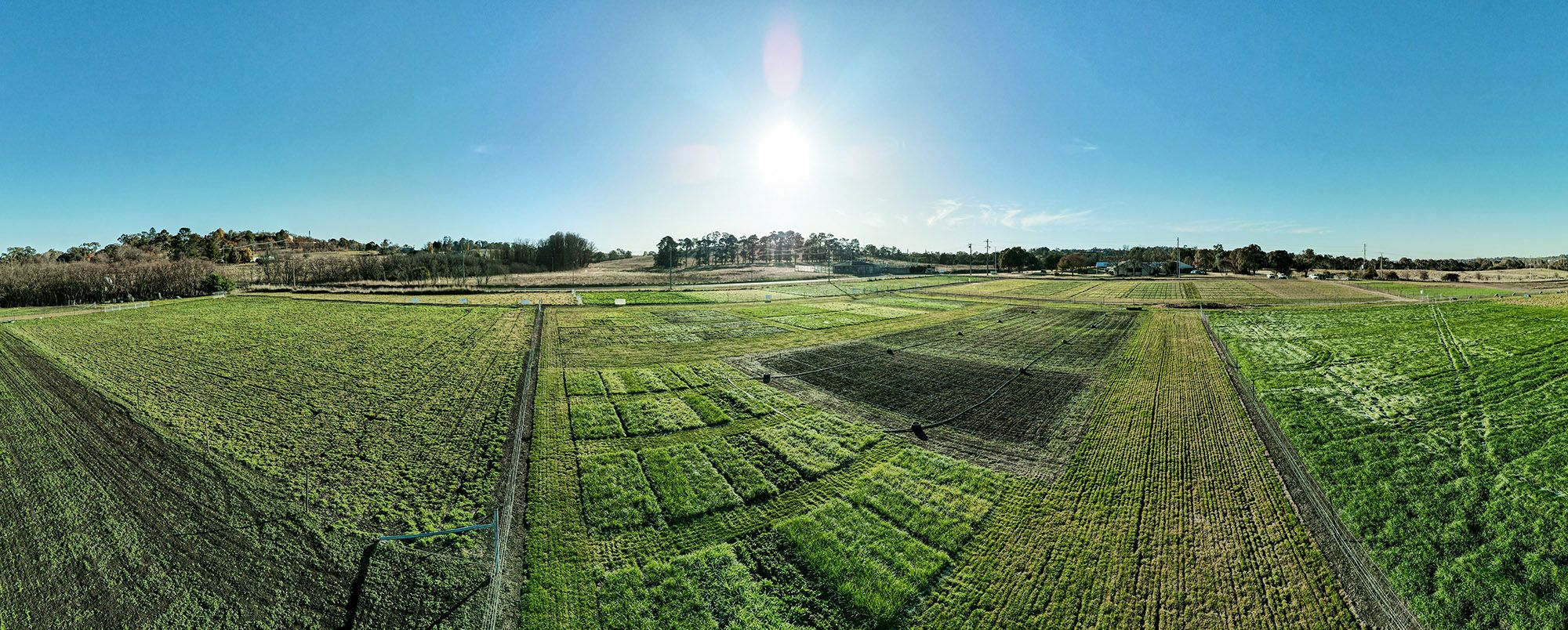
A trial at Terang, Victoria, highlights the advantage of using an elite, modern proprietary white clover.
Results from the Terang trial showed a clear production lift when Three60 AR37 perennial ryegrass was paired with proprietary Brace white clover, compared with ryegrass alone.
Trial note: Legume advantage trial sown on 21/4/23. Trial was topped and fertilised with Nitrogen until the first cut on 9/10/23. Replacement P, K, S applied after each cut, Nitrogen applied post autumn break in 2024. Trial ran until the end of 2024 and was terminated due to dry conditions.

Sown in autumn 2023 at Armidale NSW, this Legume Advantage trial shows the extra feed grown when proprietary red and white clovers are included with a summer active Savvy cocksfoot pasture.

For a proven path to greater certainty, integrating well matched, modern clover varieties delivers tangible benefits, including higher quality feed, improved animal performance, reliable Nitrogen supply and stronger long term pasture persistence.
In an increasingly uncertain environment, legumes are a key tool for productive, resilient pasture systems, especially when they are backed by science and are proven in the paddock.
Trial Note (sowing rates): Savvy was sown 8kg/ha in straight plots, and 6kg/ha in mixed plots. All white clovers were sown at 5kg/ha, all red clovers were sown at 8kg/ha. All treatment received 190kgN/ha/year.
For more information on finding the right legume for your mix, get in touch with your local DLF Seeds Sales Agronomists or reach out to your local rural retailer and ask for the latest genetics to future proof your operation.